

Do Electric Vehicles Actually Work in a New Hampshire Winter?
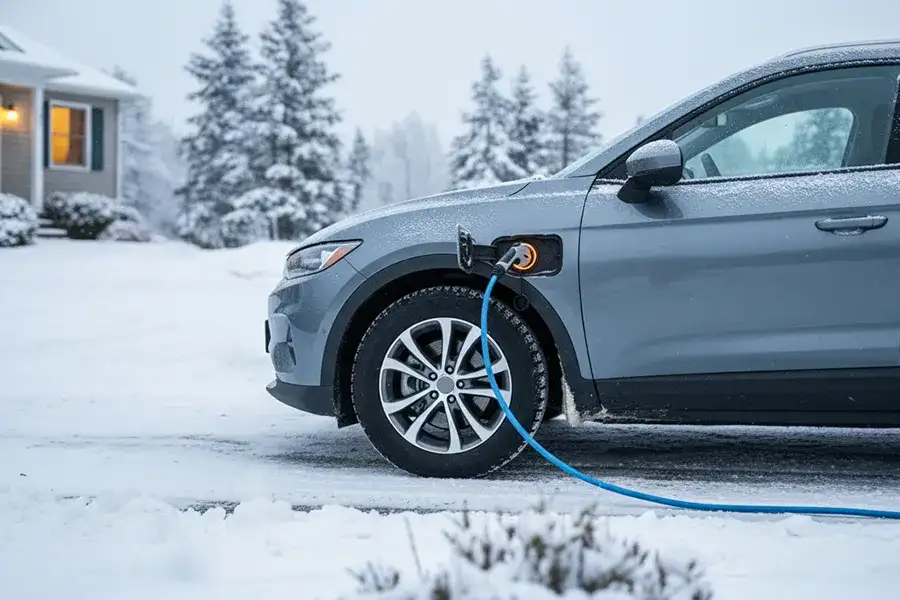
If you’ve spent any time on the Upper Valley commute or navigating the frost-heaved hills of Keene in February, you’ve probably wondered: Can an EV actually handle a Granite State winter?
It’s a valid question. We’ve all seen how cold weather can zap a smartphone battery, and when you’re driving home to Concord in a snowstorm, the last thing you want is “range anxiety.” However, modern Electric Vehicles (EVs) are designed with sophisticated thermal management and traction systems specifically built for harsh climates. At Nucar New Hampshire, we’re seeing more drivers from Lebanon to Plymouth trade in their gas-guzzlers for the efficiency and instant torque of electric power.
Let’s look at the facts and bust the top three myths about driving an EV in the New England cold.
1. The Battery Life Myth
The most common concern is that an EV battery will simply give up when the mercury drops. While cold temperatures do affect battery chemistry, it isn’t the “brick” many fear. Data indicates that while range can decrease by roughly 25% in sub-freezing conditions during highway travel, the car remains perfectly reliable for daily New Hampshire life [1].
Furthermore, newer models like the Kia EV6 and Volkswagen ID.4 have solved much of the “slow charging” issue. By using the on-board navigation to route to a charging station, these vehicles automatically “pre-condition” the battery, warming it up so it is ready to accept power quickly, even if you’ve just spent the day skiing at Gunstock Mountain Resort [2].
2. The “I’ll Be Freezing” Myth
In a traditional gas car, you have to wait for the engine to physically heat up before the vents blow warm air. In an EV, heat is near-instant. Most modern EVs now offer a Heat Pump, which is a high-efficiency system that scavenges heat from the battery and motors to warm the cabin.
- The Pro Move: Use your smartphone app (like Kia Connect or myVW) to pre-heat your car while it’s still plugged into your home charger in Tilton. This uses power from the house—not your battery—to defrost the windows and toast the seats before you even step outside.
- Efficiency Tip: Research shows that using heated seats and a heated steering wheel is much more energy-efficient than trying to heat the entire cabin volume with hot air, helping you preserve your range for that long trek through the Notch [2].
3. The Traction and Weight Myth
Many drivers are surprised to learn that EVs often have better traction than internal combustion vehicles. Because the heavy battery pack is located at the very bottom of the chassis, EVs have an incredibly low center of gravity and nearly perfect weight distribution.
Furthermore, electric motors can adjust torque to the wheels with a precision gas engines can’t match. An EV’s motor-control system can react and adjust to slipping tires up to 1,000 times per second [3]. This makes navigating a slushy climb near Lake Winnipesaukee or a muddy backroad in Gorham feel remarkably stable compared to a front-heavy gas vehicle.
Why the “Nucar Way” is Best for Your EV Journey
Transitioning to electric power is a big step, but you don’t have to do it alone. At Nucar New Hampshire, our teams in Tilton, Keene, Plymouth, Gorham, Concord, and Lebanon are trained to help you understand the tech, the charging, and the benefits of going green in the Granite State.
Whether you want the sporty AWD capability of the Kia EV6 or the family-sized utility of the VW ID.4, we have the inventory to get you through this winter and many more to come.
Everyone Loves a Nucar!
Sources:[1] CBS News / Consumer Reports, https://www.cbsnews.com/news/winter-storm-tesla-electric-vehicle-battery-performance-cold-weather/
[2] Recurrent Auto, “Winter EV Range Loss in 18 Popular Models” https://www.recurrentauto.com/research/winter-ev-range-loss
[3] Car and Driver, “How EVs Handle the Cold” https://www.caranddriver.com/reviews/a70270024/2026-lucid-air-gravity-winter-drive/







0 comment(s) so far on Do Electric Vehicles Actually Work in a New Hampshire Winter?